
Level-Funded Health Plans Explained: Predictable Payments Without Surprises
CFOs hate budget surprises. HR departments hate explaining premium spikes to leadership. And yet, year after year, traditional fully insured health plans deliver exactly that: double-digit increases with zero transparency and no way to predict what's coming next.
There's a better way. Level-funded health plans are transforming how mid-sized companies approach employee benefits, delivering the financial predictability of fully insured plans with the cost control and transparency of self-funded arrangements. If you're tired of writing blank checks to insurance carriers while wondering where your money actually goes, it's time to understand how level-funded health plans work: and why they're becoming the gold standard for companies that refuse to settle for the status quo.
What Level-Funded Health Plans Actually Are
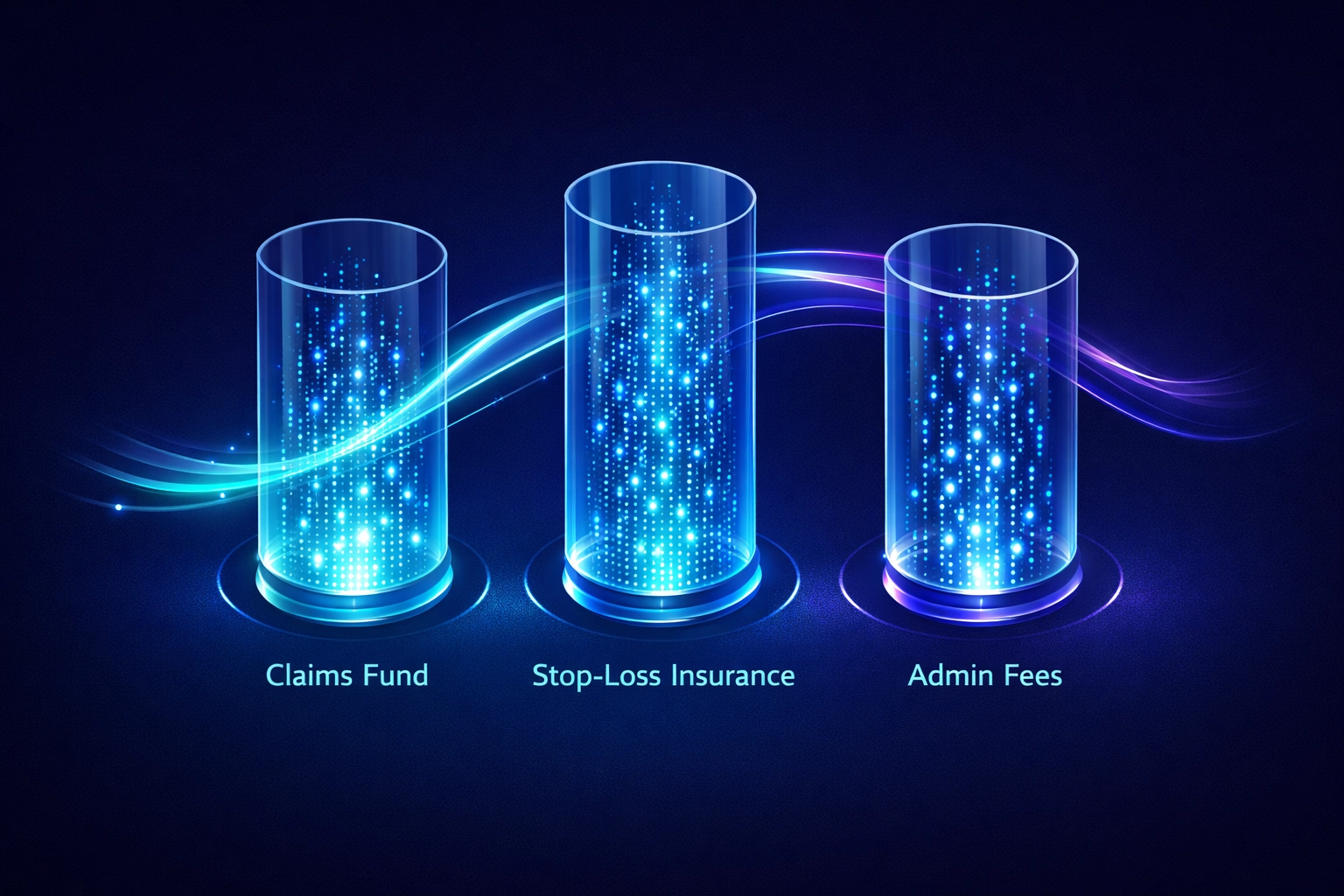
Level-funded health plans represent a hybrid model that combines the best elements of traditional insurance with self-funded cost control. Here's what makes them different: instead of paying unpredictable premiums that mysteriously increase every renewal, your company pays a fixed monthly amount that covers three specific components.
First, there's your claims fund: a predetermined amount reserved for your employees' actual healthcare expenses. Second, stop-loss insurance protects your company if claims exceed expectations. Third, administrative fees cover the third-party administrator who processes claims, handles customer service, and manages the day-to-day operations.
This isn't complicated: it's just transparent. You know exactly what you're paying for each month, and more importantly, you know where every dollar goes.
The Predictability That CFOs Actually Want
Traditional fully insured plans operate like black boxes. You pay premiums, file claims, and at renewal time, your broker delivers the bad news: another 15% increase because of "industry trends" or "utilization patterns" that no one can explain in concrete terms.
Level-funded health plans eliminate this uncertainty. Your monthly payment stays fixed throughout the year: no mid-year adjustments, no surprise bills, no emergency budget meetings. You budget the same amount in January that you'll pay in December, giving your finance team the predictability they need to forecast accurately and plan strategically.
But here's where level-funded plans deliver something fully insured plans never will: potential refunds. When your claims come in lower than projected, you don't just get a pat on the back at renewal: you get actual money back. That surplus belongs to your company, not to an insurance carrier's shareholders.
This year-end settlement process creates a fundamentally different dynamic. Instead of hoping your insurance company doesn't raise rates, you're actively incentivized to invest in employee wellness, cost containment strategies, and smart utilization management. When employees stay healthy and claims remain manageable, your company benefits directly.
Stop-Loss Protection: Your Safety Net Against the Unexpected
The biggest concern companies have when considering alternative funding arrangements is simple: "What happens if someone gets really sick?"
This is where stop-loss insurance becomes your safety net. Level-funded health plans include both specific stop-loss coverage (protecting against individual catastrophic claims) and aggregate stop-loss coverage (protecting against higher-than-expected total claims across your entire population).
Most plans set specific stop-loss thresholds between $10,000 and $100,000 per individual annually. If an employee faces a cancer diagnosis, premature birth, or other significant medical event, your stop-loss coverage kicks in once claims exceed that threshold. Your company's financial exposure is capped: you're protected from the unexpected while still maintaining control over routine healthcare spending.
This combination of fixed monthly payments and stop-loss protection delivers what CFOs need most: predictable budgeting without catastrophic risk.

How Level-Funded Plans Compare to Fully Insured Arrangements
With traditional fully insured plans, you're essentially buying a lottery ticket you hope never pays out. You pay premiums whether your employees use healthcare services or not, and when utilization is low, the insurance carrier keeps the difference. You have no access to claims data, no transparency into pricing, and no control over cost containment strategies.
Level-funded health plans flip this dynamic completely. You're still protected from catastrophic costs through stop-loss insurance, but you retain the surplus when actual claims are lower than expected. You gain access to detailed claims analytics that show exactly where healthcare dollars are going. And you maintain control over plan design, network selection, and cost management initiatives.
The financial impact is substantial. Companies switching from fully insured to level-funded arrangements typically see immediate cost reductions of 10-30% in the first year alone, with ongoing savings as they optimize plan performance using real-time data and targeted interventions.
More importantly, you're no longer subsidizing other companies in your insurance carrier's risk pool. Your rates are based on your population's actual health status and claims experience, not averaged across hundreds of unrelated businesses. When you invest in employee wellness and smart healthcare management, your company captures the financial benefits: not your insurance carrier.
Who Should Consider Level-Funded Health Plans?
Level-funded health plans work exceptionally well for companies with 25-500 employees who want the cost savings of self-funding without the administrative complexity or cash flow volatility. If your workforce is relatively stable and you're tired of double-digit premium increases, level-funding deserves serious consideration.
CFOs benefit from predictable monthly expenses that simplify budgeting and forecasting, plus the potential for year-end refunds that improve overall benefits ROI. HR departments benefit from enhanced claims transparency that enables data-driven benefits decisions and targeted wellness initiatives. Employees benefit from the same comprehensive coverage they've always had, often with improved plan designs funded by the cost savings.
Companies with active wellness programs, strong employee communication, and commitment to healthcare cost management see the strongest results. When employees understand how the plan works and engage with cost-saving tools like telemedicine, generic medications, and high-quality provider networks, everyone wins.

The Data Advantage: Where Quilt Benefits Transforms Level-Funded Success
Here's what most benefits advisors won't tell you: switching to a level-funded plan is only the first step. The real value comes from what you do with the claims data, cost containment tools, and analytics that level-funding provides access to.
This is where Quilt Benefits changes the equation completely. We don't just help you implement a level-funded plan: we provide the advanced analytics platform and cost containment infrastructure that ensures your plan performs at the highest level possible.
Our proprietary technology gives CFOs and HR leaders real-time visibility into exactly where healthcare dollars are flowing. You'll see which conditions drive the highest costs, which providers deliver the best value, and which employees might benefit from care management interventions. This isn't generic industry benchmarking: it's specific, actionable intelligence about your population.
More importantly, Quilt partners with you to implement targeted cost containment strategies that reduce claims without sacrificing care quality. From transparent pharmacy benefit management that eliminates hidden PBM markups to direct provider contracts that deliver better pricing, we provide the tools that make level-funded plans work exceptionally well.
Making Level-Funded Plans Work for Your Organization
Successfully implementing a level-funded health plan requires more than just signing a contract: it demands the right partner with the right technology and the right expertise.
First, you need accurate underwriting based on your population's actual health status and risk profile. This determines your monthly payment amount and ensures you're neither overpaying nor underestimating potential claims. Quilt's advanced predictive analytics deliver precision here, using sophisticated modeling that accounts for demographic factors, chronic conditions, and healthcare utilization patterns.
Second, you need robust stop-loss coverage with appropriate thresholds and competitive pricing. We negotiate stop-loss terms on your behalf, leveraging our relationships with top-rated carriers to secure protection that makes sense for your risk tolerance and budget.
Third, you need ongoing performance monitoring with quarterly reviews that track claims trends, identify cost-saving opportunities, and optimize plan design. Our platform automates this process, delivering insights that would typically require expensive consultants or full-time benefits analysts.

The Year-End Settlement: Where Level-Funded Plans Prove Their Value
Here's where level-funded health plans deliver something fully insured arrangements simply cannot: the potential for year-end refunds when actual claims come in lower than projected.
At the end of your plan year, your third-party administrator calculates total claims paid against the claims fund you contributed through your fixed monthly payments. If actual healthcare costs were lower than expected: perhaps because employees stayed healthier, utilized telemedicine effectively, or chose high-value providers: you receive a refund of the surplus.
This isn't a marketing gimmick or accounting trick. It's real money returned to your company that can be reinvested in enhanced benefits, wellness programs, or bottom-line savings. Companies working with Quilt Benefits average refund rates of 15-25% of their annual claims fund, delivering substantial financial benefits that compound over time.
Even in years when claims exceed projections, your stop-loss coverage protects you from catastrophic exposure. Your financial downside is limited while your upside potential remains significant: a risk-reward profile that makes CFOs and finance committees sleep comfortably at night.
Control, Transparency, and Partnership
Level-funded health plans represent more than just a different payment structure: they represent a fundamentally different relationship between your company and your benefits program. Instead of surrendering control to an insurance carrier with opaque pricing and mysterious renewal increases, you maintain oversight while gaining transparency into exactly how healthcare dollars are spent.
Quilt Benefits serves as your partner in this journey, providing not just administrative services but strategic guidance backed by industry-leading technology. We help you navigate the complexity, leverage the data, and optimize performance continuously so your level-funded plan delivers maximum value year after year.
The question isn't whether level-funded health plans work: it's whether you're ready to take control of your healthcare spending and demand better results. For CFOs tired of unpredictable budgets and HR leaders seeking transparency and cost control, level-funded arrangements with the right partner represent the future of employee benefits.
Learn more about how Quilt Benefits can help your company transition to a level-funded health plan that delivers predictable payments, exceptional transparency, and measurable cost savings without sacrificing employee coverage or care quality.